
Finance Minister Nirmala Sitharaman on Tuesday allayed apprehension that privatisation of state-owned banks would hurt financial inclusion and national interest. She said the bank nationalisation done in 1969 has not yielded the desired result as far as financial inclusion was concerned.

Finance Minister Nirmala Sitharaman on Thursday said the country needs big and world-class banks, and discussions are on with the Reserve Bank and lenders in this regard.

The Reserve Bank has asked the public to pay their income tax dues well in advance so as to avoid standing in long queues and stated that 29 agency banks are also authorised to accept such payments.

Banks were the frontrunners on the bourses early today as investors were deeming their valuations offered a chance for appreciation. \n\n
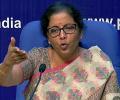
In the biggest consolidation exercise in the banking space, the government on Friday announced four major mergers of public sector banks, bringing down their total number to 12 from 27 in 2017, a move aimed at making state-owned lenders global sized banks.

As per the mega consolidation plan, Oriental Bank of Commerce and United Bank of India will merge into Punjab National Bank (PNB); Syndicate Bank into Canara Bank; Andhra Bank and Corporation Bank into Union Bank of India; and Allahabad Bank into Indian Bank. Following this merger, PNB will become second largest after the SBI, Canara Bank fourth, Union Bank of India fifth and Indian Bank seventh biggest public sector lender.

Finance secretary Rajiv Kumar was positive in formation of a committee consisting all concerned to address the issues arising out of the proposed merger of 10 banks including preserving the identity of all the banks.

'Investors should not commit fresh money to these stocks right now, unless they can hold for the next three to four years.'
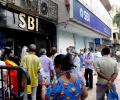
Amendments would be required in the Banking Companies (Acquisition and Transfer of Undertakings) Act, 1970 and the Banking Companies (Acquisition and Transfer of Undertakings) Act, 1980 for privatisation, sources said.

The finance ministry on Wednesday allowed all private sector banks to participate in government-related business, like collection of taxes. pension payments and small savings schemes. At the moment, only few large private sector are allowed to conduct government-related business.

Addressing the 74th Annual General Meeting of the Indian Banks' Association (IBA), she said the industry needs to imagine how Indian banking has to be in the immediate and long-term future. As far as the long-term future is concerned, she said it is going to be largely driven by digitised processes and there is a need for seamless and interconnected digital systems for a sustainable future for the Indian banking industry.

Among other demands, the unions are also seeking immediate introduction of five-day week in full and reduction of cash transaction hours and regulated working hours.

Delhi Police have arrested two individuals involved in an investment scam where a local resident was cheated of Rs 1.60 lakh. The investigation has linked the accused to a broader cyber fraud network with transactions worth approximately Rs 68 lakh across multiple states.

Banks are also weighing the option of hiring experts for help in specialised areas.

Tata Motors was the biggest gainer in the Sensex pack, rallying 2.94 per cent. It was followed by Vedanta, Bajaj Finance, Sun Pharma, ONGC, ICICI Bank, Bajaj Auto, Tata Steel, RIL, HDFC duo, L&T and SBI, rising up to 2.78 per cent.

Corporation Bank is the biggest beneficiary of this round of capital infusion with Rs 9,086 crore of funding, followed by Allahabad Bank with Rs 6,896 crore.

Bank unions - officers and workmen - had buried their differences and sat across the table on August 29 to work out a fresh deal with the IBA involving a 20 per cent wage hike.
The country's largest lender State Bank of India will get the largest sum of Rs 8,800 crore as government's capital infusion.

Business is down to such an extent that last year these firms could not even meet RBI's capital norm of Rs 50 million for partnerships and Rs 100 million for public and private firms in this line of business.

Bad loans of PSBs are at Rs 20 trillion. Most of it is, I sense, due to corruption and behest lending. Nobody pays a price for this charade. Not the promoters, the bankers, RBI officials, finance ministry bureaucrats or politicians, points out Debashis Basu.
All transfers and promotions for next financial year will be decided by respective banks, not by the merged entity.

Traditionally, most PSUs have been cash-rich, which added to their value. However, the government has been tapping regularly into their cash resources to boost revenue for the exchequer

Over 25,600 cases of banking fraud reported up to December 21, 2017, says Minister RS Prasad.
.jpg)
With new private banks in the play, the going could become more difficult for the old-school state-run banks, already losing business and market position, forcing them to think hard towards consolidating and forming larger entities to garner big-ticket deals.

Sensex eneded 374 points higher on rate cut expectation from the RBI.

The Sensex closed higher by 170 points at 26,128 and the Nifty rose 59 points to end at 7,943.

The 30-share Sensex closed up 34 points at 27,831 and the 50-share Nifty ended up 15 points at 8,356.
To begin with, there would be the immediate integration of various technology stacks. This would create more business for global consulting and IT services entities such as KPMG, PwC, EY, Accenture and IBM, among others. Indian service providers - Infosys, Tata Consultancy Services (TCS), and Wipro, for instance - would also cash in.
Experts attribute the lower target to increased allocation under the credit guarantee scheme for small businesses. Out of the Rs 3.21 trillion worth loans sanctioned under the Pradhan Mantri Mudra Yojana (PMMY) in the last financial year, Rs 3.12 trillion were disbursed to entrepreneurs, according to official data.

The S&P BSE Sensex closed 318 points at 24,455 and the Nifty50 shed 99 points to end at 7,438.

Government to infuse funds in cash-strapped banks.

The S&P BSE Midcap and the S&P BSE Smallcap indices under-performed to lose 0.8% and 1.6%
